What are you looking for?
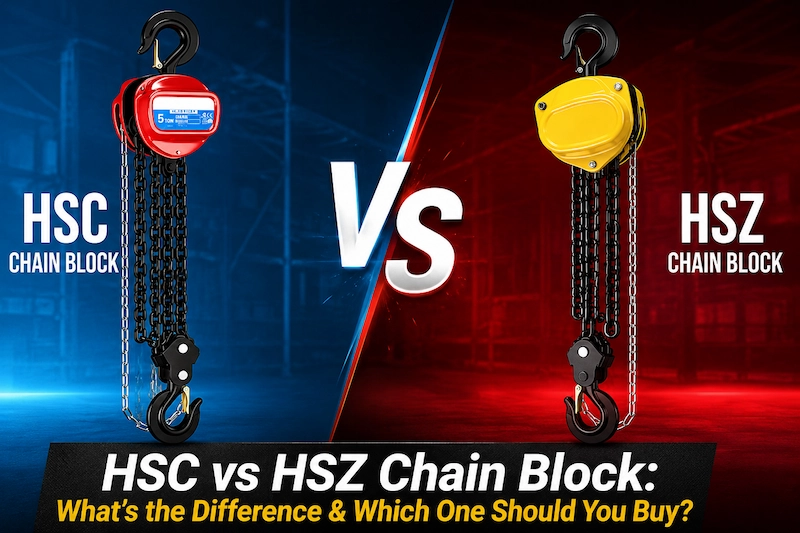
HSC and HSZ chain blocks are two manual chain hoist series used for vertical lifting without electrical power. They overlap across many common capacities, including 1 ton, 2 ton, 3 ton, 5 ton, 10 ton and 20 ton, which can make it difficult for buyers to determine which model is more suitable.
However, neither series is universally better. Based on the listed product specifications, the HSC and HSZ series are very similar at several shared capacities. The most meaningful differences appear in their available capacity ranges, minimum hook distances and a small number of capacity-specific operating-force values.
For example, the HSZ series includes a 0.5 ton model, while the HSC series begins at 1 ton. At the other end of the range, HSC is available up to 30 tons, while the listed HSZ range ends at 20 tons. For 2 ton, 3 ton, 5 ton and 10 ton models, the stated minimum hook distances and hand-pull forces are the same.
This guide compares the actual specifications of HSC and HSZ chain blocks and explains how to select the appropriate model according to load capacity, lifting height, headroom and operating conditions.
The HSZ chain block is a hand-operated chain hoist designed for lifting and lowering suspended loads. The operator pulls the hand chain, which transfers force through the internal gear and braking system to move the load chain.
The listed HSZ range includes 0.5 ton, 1 ton, 2 ton, 3 ton, 5 ton, 10 ton and 20 ton models. Standard lifting heights are generally 2.5 meters for smaller capacities and 3 meters for larger models, although customized lifting heights may be available for project orders.
HSZ chain blocks can be used for:
Construction and on-site installation
Machinery installation and maintenance
Manufacturing and fabrication workshops
Warehouse and loading-area lifting
Automotive and equipment repair
Agricultural and remote-site maintenance
Its 0.5 ton option makes the HSZ series particularly relevant for buyers who need a lightweight manual chain hoist for loads below 1 ton.
The HSC chain block is another hand-operated chain hoist series for industrial vertical lifting. Like the HSZ model, it uses a hand chain, load chain, gears, hooks and a mechanical braking system to raise, hold and lower loads without an electrical power supply.
The listed HSC range includes 1 ton, 2 ton, 3 ton, 5 ton, 10 ton, 20 ton and 30 ton capacities. This gives the HSC series a higher maximum listed capacity than the HSZ range.
HSC chain blocks can be considered for:
General industrial maintenance
Machinery and equipment installation
Construction lifting
Fabrication and assembly work
Heavy equipment handling
Specialized lifting requirements up to 30 tons
Buyers should not assume that the HSC model always requires less hand-pull force or has a smaller body. The actual difference depends on the selected capacity. Specifications should therefore be compared model by model.
| Comparison Item | HSC Chain Block | HSZ Chain Block |
|---|---|---|
| Available Capacities | 1, 2, 3, 5, 10, 20 and 30 ton | 0.5, 1, 2, 3, 5, 10 and 20 ton |
| Lowest Listed Capacity | 1 ton | 0.5 ton |
| Highest Listed Capacity | 30 ton | 20 ton |
| Standard Lift for 1–2 Ton Models | 2.5 m | 2.5 m |
| Standard Lift for 3 Ton and Larger Models | 3 m | 3 m |
| 0.5 Ton Model | Not listed | Available |
| 30 Ton Model | Available | Not listed |
| 1 Ton Minimum Hook Distance | 306 mm | 270 mm |
| 1 Ton Hand Pull at Full Load | 304 N | 309 N |
| 20 Ton Minimum Hook Distance | 890 mm | 1,000 mm |
Based on the listed specifications, the two series are very similar at 2 ton, 3 ton, 5 ton and 10 ton capacities. Buyers selecting one of these shared capacities should compare availability, quotation, lifting height, documentation, spare-parts requirements and project preferences rather than assuming that one series is automatically more efficient.
| Rated Capacity | Minimum Hook Distance | Hand Pull at Full Load | Main Selection Difference | ||
|---|---|---|---|---|---|
| HSC | HSZ | HSC | HSZ | Recommendation | |
| 0.5 Ton | Not listed | Available | Not listed | Refer to HSZ specifications | Choose HSZ when a 500 kg rated model is required. |
| 1 Ton | 306 mm | 270 mm | 304 N | 309 N | HSZ provides shorter listed headroom; HSC has slightly lower listed hand pull. |
| 2 Ton | 444 mm | 444 mm | 314 N | 314 N | Compare price, availability, documentation and accessory requirements. |
| 3 Ton | 486 mm | 486 mm | 343 N | 343 N | The listed hook distance and hand-pull force are the same. |
| 5 Ton | 616 mm | 616 mm | 383 N | 383 N | Select according to quotation, supply preference and project configuration. |
| 10 Ton | 700 mm | 700 mm | 392 N | 392 N | The listed hook distance and hand-pull force are the same. |
| 20 Ton | 890 mm | 1,000 mm | 392 N | 392 N | HSC provides a shorter listed minimum hook distance. |
| 30 Ton | 980 mm | Not listed | 450 × 2 N | Not listed | Choose HSC when a listed 30 ton manual chain block is required. |
The figures above should be used as product-selection references. Final specifications, lifting height, chain configuration and supplied accessories should be confirmed in the quotation before ordering.
Minimum hook distance, also called closed headroom or minimum hook-to-hook distance, is the vertical distance between the upper and lower hooks when the chain block is raised to its highest usable position.
A shorter minimum hook distance provides more usable lifting travel where the available overhead space is limited. This can be important beneath low beams, inside machinery, in workshops with restricted ceiling height or when the load must be raised as close as possible to the suspension point.
At 1 ton, the listed HSZ minimum hook distance is 270 mm, compared with 306 mm for the HSC model. The HSZ model may therefore be more suitable for a 1 ton application where every millimeter of headroom matters.
At 20 tons, the situation is reversed. The HSC model has a listed minimum hook distance of 890 mm, while the HSZ model is listed at 1,000 mm. In this capacity, HSC may provide an advantage when vertical installation space is restricted.
For 2 ton, 3 ton, 5 ton and 10 ton capacities, the listed minimum hook distances are the same for both series.
It is not accurate to say that every HSC chain block requires less hand-pull force than the equivalent HSZ model.
At 1 ton, the listed HSC hand pull is 304 N, while the HSZ hand pull is 309 N. The HSC figure is slightly lower, but the difference is only 5 N.
At 2 ton, 3 ton, 5 ton, 10 ton and 20 ton capacities, the listed hand-pull forces are the same:
2 ton: 314 N for both series
3 ton: 343 N for both series
5 ton: 383 N for both series
10 ton: 392 N for both series
20 ton: 392 N for both series
Buyers should therefore compare the actual capacity-specific data rather than relying on a general statement that HSC is always easier to operate.
If a chain block suddenly requires substantially more effort than expected during use, stop the operation and check for overloading, twisted load chain, misalignment, side loading, contamination or internal damage. Do not extend the operating chain or use unauthorized methods to increase pulling force.
| Lifting Requirement | Recommended Series | Selection Reason |
|---|---|---|
| Load capacity below 1 ton | HSZ | The HSZ range includes a 0.5 ton model, while the listed HSC range begins at 1 ton. |
| 1 ton lifting with very limited headroom | HSZ | The listed minimum hook distance is 270 mm, compared with 306 mm for HSC. |
| 1 ton lifting where slightly lower listed hand pull is preferred | HSC | HSC is listed at 304 N and HSZ at 309 N, although the difference is small. |
| 2 ton lifting | Compare both | The listed minimum hook distance and hand-pull force are the same. |
| 3 ton lifting | Compare both | Both list a 486 mm minimum hook distance and 343 N hand pull. |
| 5 ton lifting | Compare both | Both list a 616 mm minimum hook distance and 383 N hand pull. |
| 10 ton lifting | Compare both | Both list a 700 mm minimum hook distance and 392 N hand pull. |
| 20 ton lifting with restricted vertical space | HSC | The HSC minimum hook distance is listed at 890 mm, compared with 1,000 mm for HSZ. |
| 30 ton manual lifting requirement | HSC | A 30 ton HSC model is listed, while no 30 ton HSZ model is shown. |
| Existing HSZ maintenance or spare-parts system | HSZ may be preferred | Continuing with a familiar series may simplify maintenance, operator training and spare-parts management. |
| Existing HSC purchasing specification | HSC may be preferred | Standardizing one product series can simplify procurement, documentation and replacement planning. |
The working environment alone does not determine whether HSC or HSZ is the better choice. Construction buyers should first consider the load capacity, lifting height, available anchor points, transportation requirements and available headroom.
An HSZ chain block may be the more relevant option when a portable 0.5 ton model is required or when a 1 ton application has especially limited vertical space. An HSC chain block may be considered for construction loads up to 30 tons or for a 20 ton application where the shorter listed hook distance is beneficial.
For common 2 ton, 3 ton, 5 ton and 10 ton construction lifting, the listed hook distances and operating forces are the same. In these capacities, compare the supplied configuration, documentation, quotation, availability and spare-parts support.
Regardless of the selected series, the chain block should be suspended from a properly rated beam, tripod, gantry or anchor point. The supporting structure, slings and below-the-hook attachments must all be suitable for the complete suspended load.
Manufacturing facilities and maintenance workshops should evaluate how frequently the hoist will be operated and how much manual chain movement is required during each cycle.
For occasional lifting, both HSC and HSZ chain blocks can provide a practical solution when the selected capacity, headroom and lifting height match the application.
For 2 ton, 3 ton, 5 ton and 10 ton loads, the listed hand-pull values do not show an operating-force advantage for either series. Buyers should therefore avoid choosing HSC solely on the assumption that it will always require less effort.
If lifting is repetitive, production speed is important or operators must raise loads through long vertical distances, an electric hoist may be more appropriate than either manual chain block. Electric lifting can reduce operator effort and improve cycle efficiency when the duty rating is correctly selected.
Lifting height is the vertical distance that the lower hook must travel. It is different from the installation height and minimum hook distance.
The listed standard lift for smaller HSC and HSZ models is generally 2.5 meters, while capacities of 3 tons and above generally have a standard 3-meter lift. Longer lifting heights may be available, but they increase the amount and weight of the load chain.
Higher-capacity models use multiple load-chain falls to distribute the suspended load. Additional chain falls increase the amount of chain that must move when the load is raised and can increase the overall weight and installation requirements of the hoist.
Before requesting a quotation, provide:
Maximum total suspended load
Required vertical hook travel
Available minimum headroom
Preferred hand-chain operating height
Fixed-hook or trolley-mounted installation
Indoor or outdoor operating conditions
This information is more useful than simply requesting a 2 ton or 5 ton chain block without explaining the lifting conditions.
The listed specifications do not support a general conclusion that every HSC chain block is more durable than every HSZ chain block.
Service life depends on manufacturing quality, actual load conditions, inspection frequency, lubrication, storage, environmental exposure and whether the hoist is operated correctly.
For either series, durability can be reduced by:
Overloading the chain block
Pulling the load at an angle
Twisting or knotting the load chain
Side-loading the hooks
Using damaged slings or attachment points
Operating with worn brake or chain components
Leaving the hoist exposed to rain or corrosive materials
Buyers should compare the supplier’s inspection procedures, test documents, spare-parts availability and after-sales support rather than relying only on the series name.
Maintenance procedures are generally similar for both series. The inspection interval should reflect lifting frequency, load conditions and the operating environment.
Confirm the identification plate and rated capacity are readable.
Inspect the upper and lower hooks for deformation, cracks or excessive opening.
Check that the hook safety latches operate correctly.
Inspect the load chain for twisting, corrosion, damaged links or abnormal wear.
Confirm that the hand chain moves smoothly.
Test lifting, holding and lowering functions without applying the full working load.
Measure load-chain wear and elongation.
Inspect gears, bearings, shafts and brake components.
Apply suitable lubrication according to the maintenance instructions.
Check fasteners and load-bearing components.
Replace damaged components with compatible parts.
Record inspections and repairs when required by the workplace lifting-equipment program.
A chain block that has been overloaded, dropped, damaged or exposed to severe corrosion should be removed from service until it has been inspected by qualified personnel.
Purchase price cannot be compared accurately by series name alone. Pricing depends on rated capacity, lifting height, load-chain length, hand-chain length, packaging, order quantity, certification, branding and other customization requirements.
A quotation for a standard 1 ton model with a 2.5-meter lift cannot be directly compared with a customized 1 ton model supplied with a longer chain, trolley, special packaging or additional documentation.
Buyers should request HSC and HSZ quotations using the same:
Rated capacity
Lifting height
Hand-chain length
Suspension arrangement
Packaging method
Testing and documentation requirements
Order quantity
This provides a more meaningful comparison than assuming that HSZ is always cheaper or HSC always offers better lifetime value.
Not in every capacity or application. HSZ is available in a 0.5 ton model and has a shorter listed minimum hook distance at 1 ton. HSC is available up to 30 tons and has a shorter listed hook distance at 20 tons. At 2 ton, 3 ton, 5 ton and 10 ton capacities, their listed hook distances and hand-pull forces are the same.
Choose according to the installation conditions. The 1 ton HSZ model has a listed minimum hook distance of 270 mm, making it more suitable where headroom is limited. The 1 ton HSC model has a slightly lower listed hand pull of 304 N compared with 309 N for HSZ.
The listed 5 ton HSC and HSZ models both have a 616 mm minimum hook distance and a hand pull of 383 N. Compare price, availability, lifting-height requirements, spare parts, documentation and existing purchasing preferences.
Within the product ranges currently listed on this website, HSC includes a 30 ton model, while HSZ is listed up to 20 tons. A 30 ton lifting application requires detailed evaluation of the supporting structure, rigging arrangement, available space and manual operating conditions.
A compatible plain, geared or powered trolley may be used when the load must travel horizontally along a suitable beam. The trolley capacity, beam flange width, supporting structure and hoist suspension must be checked before installation.
Outdoor use may be possible when the equipment configuration and maintenance procedures are suitable for the environment. After use, clean and dry the chain block and inspect it for moisture, corrosion and contamination. Continuous exposure to rain, salt spray or chemicals may require additional protection.
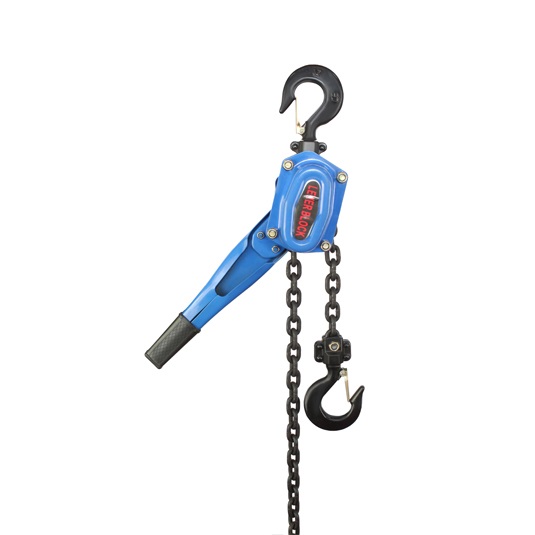
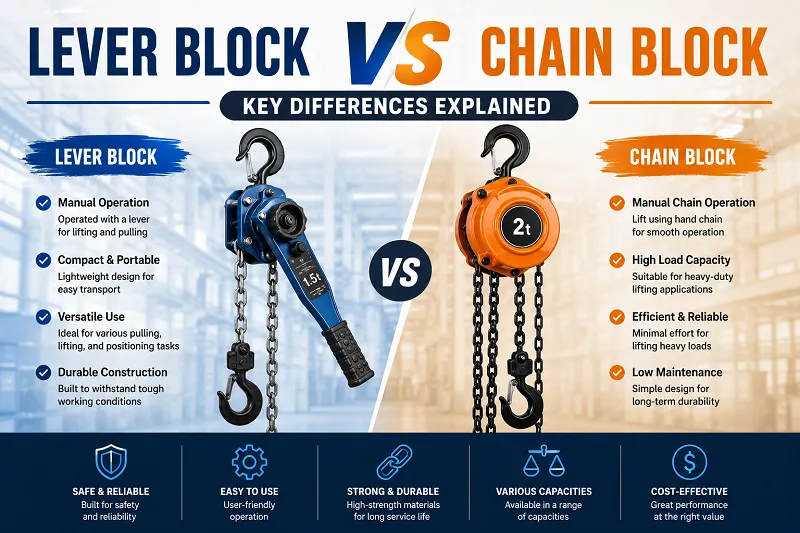
Standard hand chain blocks are primarily intended for vertical lifting with the load aligned below the hoist. For horizontal pulling, tensioning or multi-angle positioning, a lever block may be more appropriate.
Manual chain blocks can be used for intermittent industrial lifting, but frequent production cycles and long lifting distances may create substantial operator effort. An electric chain hoist should be considered when lifting speed, repetition and labor efficiency are major requirements.
Select an HSZ chain block when you need a listed 0.5 ton model or a 1 ton model with shorter minimum headroom. Select an HSC chain block when the required capacity is 30 tons or when a 20 ton application benefits from its shorter listed minimum hook distance.
For 2 ton, 3 ton, 5 ton and 10 ton lifting requirements, the listed hook distances and hand-pull forces are the same. In these capacities, compare both products according to:
Required lifting height
Available headroom
Product availability and lead time
Quotation and order quantity
Packaging and OEM requirements
Inspection and documentation requirements
Spare-parts and maintenance preferences
Review the complete 0.5–20 ton HSZ chain hoist specifications or view the 1–30 ton HSC chain block specifications before making a final decision.
You can also explore our complete manual chain hoist range or contact Huaxin with your required capacity, lifting height, available headroom and operating conditions for a model recommendation and quotation.