Lever blocks and chain blocks serve different roles in lifting and material handling. A lever block is designed for controlled pulling, positioning, and lifting in tight or complex environments, while a chain block is optimized for vertical lifting of loads over a fixed point. Choosing between them depends less on load capacity alone and more on application scenario, working posture, precision requirements, and site conditions.
Understanding these differences is critical for safe operation, cost control, and long-term equipment performance.
What Is the Main Difference Between a Lever Block and a Chain Block?
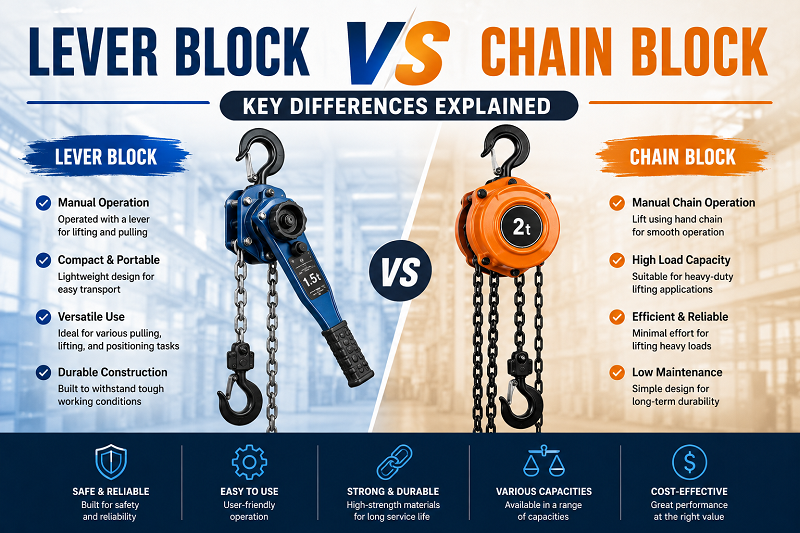
The fundamental difference lies in how force is applied and controlled.
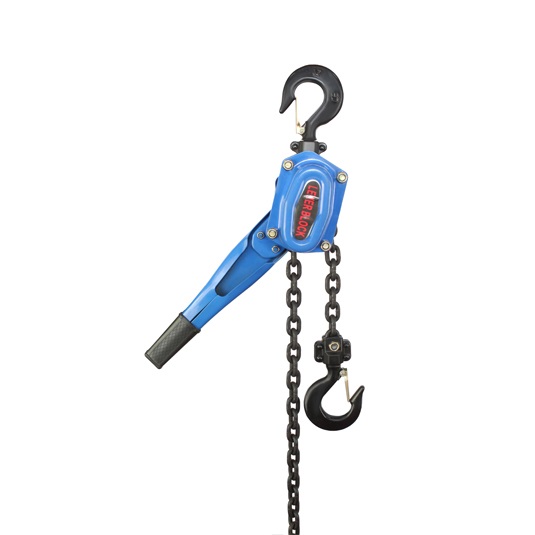
A lever block uses a ratcheting lever handle to move the load incrementally. It allows the operator to lift, lower, pull, or tension loads from multiple angles.
A chain block relies on continuous hand-chain rotation and is primarily intended for vertical lifting directly beneath the hoist.
In practice, lever blocks are more versatile for on-site adjustment and positioning, while chain blocks excel in stable, repetitive vertical lifting tasks.
How Does a Lever Block Work Compared to a Chain Block?
A lever block operates through a ratchet and pawl mechanism connected to a short lever arm. Each lever stroke advances the load chain in small increments, enabling precise control under load. This mechanism also allows the operator to work from the side of the load, not directly below it.
A chain block uses a hand chain wheel and gear reduction system. Pulling the hand chain rotates internal gears, lifting the load chain vertically. The operator must typically stand beneath or very close to the load line.
From an operational standpoint, lever blocks offer greater flexibility, especially in confined or obstructed workspaces.
Which Is Better for Horizontal Pulling or Load Positioning?
For horizontal pulling, tensioning, or diagonal load adjustment, the lever block is the clear choice.
Common applications where a lever block outperforms a chain block include:
Equipment alignment and positioning
Steel structure assembly
Pipeline installation and tensioning
Shipbuilding and maintenance
Power line and utility work
Chain blocks are not designed for horizontal pulling and should not be used for side loading unless explicitly approved by the manufacturer.
Load Capacity Comparison: Are Lever Blocks Weaker Than Chain Blocks?
This is a common misconception. Lever blocks are not inherently weaker.
Both tools are available in comparable rated capacities, commonly:
0.75 ton
1.5 ton
3 ton
6 ton
9 ton and above (industrial models)
However, lever blocks often feel “lighter” because they are built for mobility and field use, with compact housings and shorter lift heights. Chain blocks typically offer longer standard lifting heights, making them better suited for workshop or fixed lifting stations.
Capacity selection should always be based on working load limit (WLL), duty cycle, and safety factor—not tool type alone.
Which Is Safer: Lever Block or Chain Block?
Safety depends more on correct application than on the product itself.
Lever blocks provide:
Better control during load positioning
Easier operation in restricted spaces
Reduced need to stand under suspended loads
Chain blocks provide:
Stable vertical lifting with minimal side forces
Simpler operation for repetitive lifts
Lower risk of misuse in straightforward applications
In high-risk environments such as construction sites or maintenance work at height, lever blocks often reduce operational risk by allowing off-axis operation. In production workshops, chain blocks remain the safer and more efficient choice.
Can a Lever Block Be Used for Vertical Lifting?
Yes, a lever block can be used for vertical lifting within its rated capacity and manufacturer guidelines.
That said, lever blocks are best suited for:
Short lift heights
Precision lifting
Intermittent use
For long vertical lifts or frequent repetitive lifting, chain blocks are generally more efficient and ergonomic.
Precision and Control: Which Tool Offers Better Load Adjustment?
Lever blocks offer superior precision.
Because each lever stroke moves the load incrementally, operators can:
Fine-tune alignment
Adjust millimeters at a time
Hold tension steadily during installation
This makes lever blocks indispensable in applications such as:
Machinery installation
Structural alignment
Flange and pipe positioning
Chain blocks, while smooth, are less precise for micro-adjustments under load.
Size, Weight, and Portability Differences
Lever blocks are typically:
More compact
Lighter in weight
Easier to transport between job sites
Chain blocks are:
Bulkier due to longer lift chains
Better suited for permanent or semi-permanent installations
Commonly mounted on beams, trolleys, or gantries
For mobile teams or outdoor projects, the portability of a lever block significantly improves efficiency.
Maintenance and Durability Considerations
From a maintenance perspective:
Lever blocks have more moving components exposed to field conditions and require regular inspection
Chain blocks operate in more controlled environments and often have longer service intervals
Both require:
Periodic load chain inspection
Brake and ratchet checks
Lubrication according to usage frequency
In harsh environments, choosing corrosion-resistant finishes and higher-grade load chains is critical, regardless of tool type.
Typical Industry Applications Compared
| Application | Recommended Tool |
|---|---|
| Vertical lifting in workshops | Chain block |
| Equipment positioning | Lever block |
| Steel structure installation | Lever block |
| Repetitive overhead lifting | Chain block |
| Confined space operations | Lever block |
| Assembly lines | Chain block |
| Field maintenance work | Lever block |
How to Choose Between a Lever Block and a Chain Block
When selecting the right tool, consider:
Direction of force (vertical vs multi-directional)
Required precision
Workspace constraints
Frequency of use
Operator safety and ergonomics
In many industrial operations, both tools are complementary rather than interchangeable. Experienced lifting professionals often keep lever blocks for adjustment and positioning, and chain blocks for primary lifting.
Final Perspective from an Industry Supplier
From a product and sales standpoint, misuse often stems from selecting equipment based on price instead of application. A properly chosen lever block not only improves operational efficiency but also reduces labor time, minimizes risk, and extends equipment life.
For buyers and engineers evaluating lifting solutions, understanding these functional differences is essential to building a safer and more productive worksite.
If you need help selecting the appropriate lever block specification for your application—capacity, lift height, chain grade, or compliance standards—working with an experienced lifting equipment supplier makes a measurable difference in both safety and cost control.