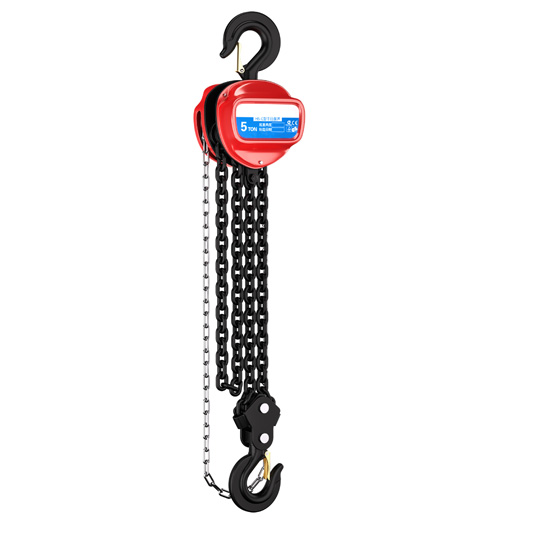
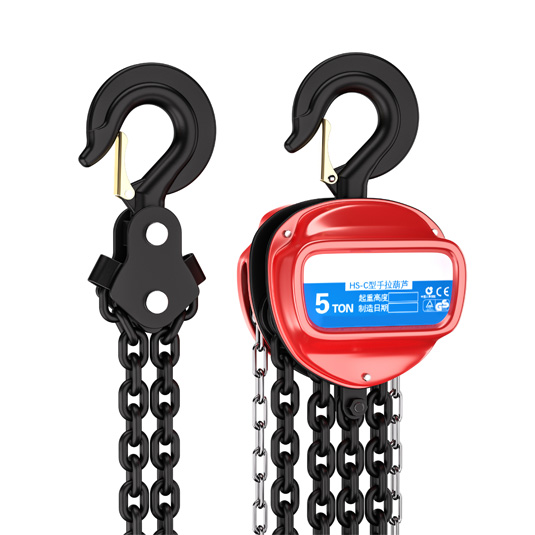
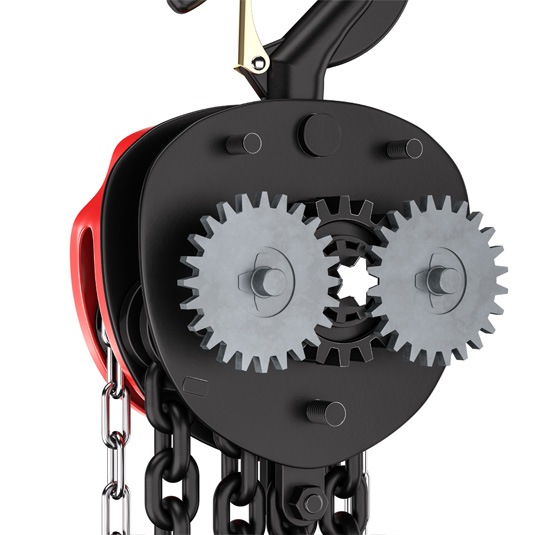
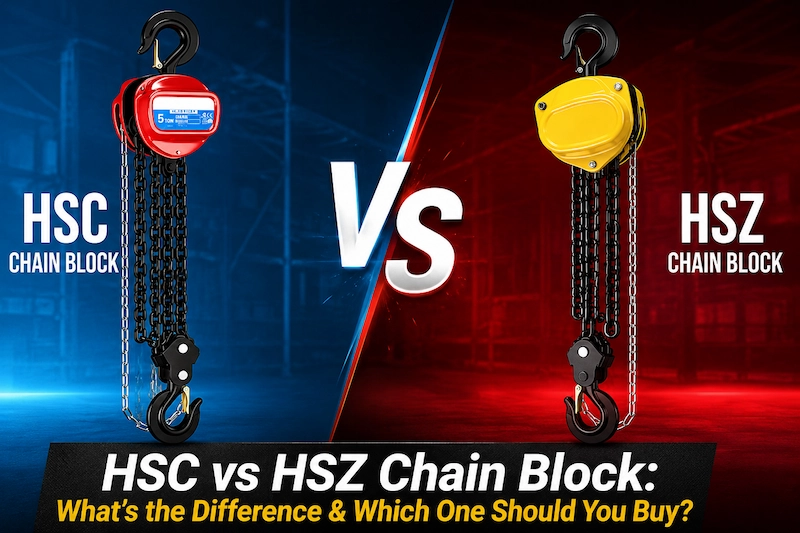
Specifications of HSC Chain Hoist
| Model | Capacity (T) | Standard lifting height (M) | Test load (T) | Min distance from hook to hook (MM) | Hand power at full load (N) | No.of load chain |
| HS-C1 | 1 | 2.5 | 1.5 | 306 | 304 | 1 |
| HS-C2 | 2 | 2.5 | 3 | 444 | 314 | 2 |
| HS-C3 | 3 | 3 | 4.5 | 486 | 343 | 2 |
| HS-C5 | 5 | 3 | 7.5 | 616 | 383 | 2 |
| HS-C10 | 10 | 3 | 12.5 | 700 | 392 | 4 |
| HS-C20 | 20 | 3 | 25 | 890 | 392 | 8 |
| HS-C30 | 30 | 3 | 37.5 | 980 | 450*2 | 12 |
Features of HSC Chain Hoist
1. Capacity: 1-30 Ton.
2. Standard lifting height: 2.5/3 M.
3. Adopt the international standard, safe and reliable, durable use.
4. High performance, easy maintance.
5. High toughness, small volume, light weight.
6. Small hand pulling, high strength of mechanism.
7. Compact structure, good appearance.
8. Lifting cargo in no power work.
9. OEM is available, can be customized.
1–30 Ton HSC Chain Block Specifications and Selection
The 1–30 ton HSC chain block range includes seven standard load capacities for different industrial lifting requirements. Capacity should be selected according to the total suspended load, including the item being lifted, slings, lifting beams, clamps and other below-the-hook attachments.
| HSC Model | Rated Capacity | Standard Lift | Test Load | Minimum Hook Distance | Hand Pull at Full Load | Load Chain Falls |
|---|
| HS-C1 | 1 ton | 2.5 m | 1.5 ton | 306 mm | 304 N | 1 |
| HS-C2 | 2 ton | 2.5 m | 3 ton | 444 mm | 314 N | 2 |
| HS-C3 | 3 ton | 3 m | 4.5 ton | 486 mm | 343 N | 2 |
| HS-C5 | 5 ton | 3 m | 7.5 ton | 616 mm | 383 N | 2 |
| HS-C10 | 10 ton | 3 m | 12.5 ton | 700 mm | 392 N | 4 |
| HS-C20 | 20 ton | 3 m | 25 ton | 890 mm | 392 N | 8 |
| HS-C30 | 30 ton | 3 m | 37.5 ton | 980 mm | 450 × 2 N | 12 |
1 Ton HSC Chain Block
The 1 ton HSC chain block is the smallest model in the HSC range and is suitable for loads weighing up to 1,000 kg. It has a standard lifting height of 2.5 meters, a minimum hook-to-hook distance of 306 mm and a single load-chain fall.
This model can be considered for general workshop maintenance, equipment installation and light industrial handling. For applications where installation height is particularly limited, compare its headroom with the 1 ton HSZ chain hoist before ordering.
2 Ton HSC Chain Block
The 2 ton HSC chain block uses two load-chain falls and has a minimum hook distance of 444 mm. It is suitable for machinery installation, fabrication work, warehouse maintenance and other medium-duty vertical lifting tasks.
The standard lifting height is 2.5 meters. Buyers requiring a longer lift should provide the actual hook travel, installation height and hand-chain length when requesting a quotation.
3 Ton HSC Chain Block
The 3 ton HSC chain block has a standard 3-meter lift and a rated test load of 4.5 tons. It can be used for heavier machinery components, industrial equipment installation and construction-related lifting.
Before purchase, confirm that the overhead beam, trolley, suspension point and lifting accessories are all rated for the complete suspended load.
5 Ton HSC Chain Block
The 5 ton HSC chain block is designed for heavy machinery maintenance, industrial assembly and positioning of larger fabricated components. Its minimum hook-to-hook distance is 616 mm, and the stated hand pull at full load is 383 N.
Because a 5 ton model is larger and heavier than lower-capacity hoists, buyers should check the available headroom, operator access and method used to install or remove the hoist.
10 Ton HSC Chain Block
The 10 ton HSC chain block uses four load-chain falls to distribute the suspended load. It has a standard 3-meter lifting height and a minimum hook distance of 700 mm.
This model is suitable for heavy industrial maintenance and equipment handling where electric power is unavailable or lifting is intermittent. The supporting structure and all rigging components must be selected for the full system load.
20 Ton HSC Chain Block
The 20 ton HSC chain block uses eight load-chain falls and has a minimum hook distance of 890 mm. Compared with the listed 20 ton HSZ model, the HSC version provides a shorter minimum hook distance, which may be useful where available vertical space is limited.
Because of the equipment size, chain weight and manual operating requirements, the complete installation and lifting procedure should be reviewed before purchase.
30 Ton HSC Chain Block
The 30 ton HSC chain block is the highest-capacity model in the current HSC range. It uses twelve load-chain falls, has a standard 3-meter lift and a minimum hook distance of 980 mm.
This model is intended for specialized heavy-load applications. Buyers should provide detailed information about the load, supporting structure, lifting frequency, available space and rigging arrangement so that the complete configuration can be evaluated.
How to Select the Correct HSC Chain Block Capacity
Select an HSC model whose rated capacity is equal to or greater than the complete suspended load. Do not select capacity according to the item weight alone if slings, beams, clamps or other lifting attachments add additional weight.
Also compare:
Required lifting height
Available hook-to-hook space
Hand-chain operating position
Number of load-chain falls
Supporting beam or anchor capacity
Fixed-hook or trolley-mounted installation
Indoor, outdoor or corrosive working conditions
For loads below 1 ton, review the 0.5 ton HSZ chain hoist. For a detailed comparison across shared capacities, read the HSC vs HSZ chain block buying guide.