What are you looking for?
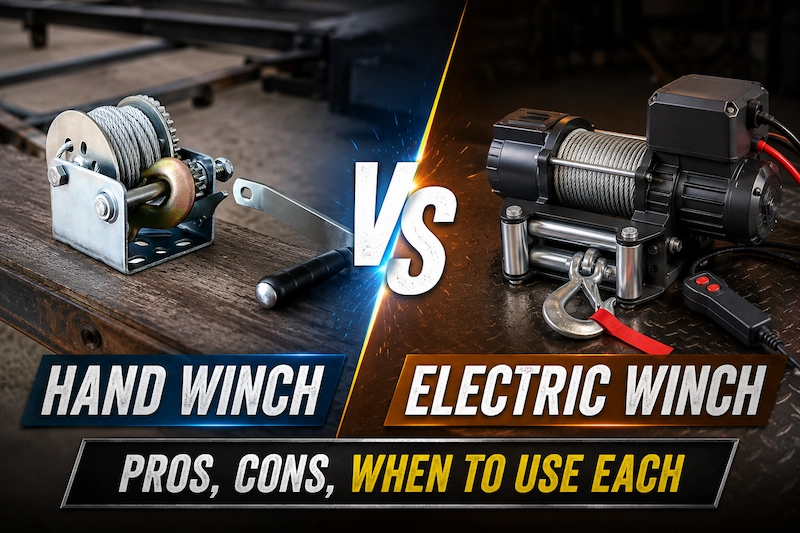
Choosing between a hand winch and an electric winch is a common challenge for buyers involved in lifting, pulling, towing, positioning, or material handling operations. While both devices are designed to move loads using a drum and cable, their performance, operating costs, installation requirements, and ideal applications differ significantly.
In general, a hand winch is best suited for occasional lifting or pulling tasks where simplicity, portability, and low cost are priorities. An electric winch is the preferred solution for frequent operation, heavier loads, higher productivity, and reduced manual effort.
This guide compares hand winches and electric winches in detail to help industrial buyers, contractors, warehouse operators, and equipment owners choose the right solution.
A hand winch is a manually operated mechanical device that uses a handle, gear system, and drum to pull, lift, or position loads.
Since no electricity is required, hand winches are widely used in locations where power is unavailable or where lifting tasks are relatively infrequent.
Common applications include:
Boat trailers
Utility trailers
Agricultural equipment
Small workshops
Construction sites
Material positioning tasks
An electric winch uses an electric motor to rotate the drum and move loads through a wire rope or synthetic rope.
Electric winches are commonly installed on:
Trucks
Off-road vehicles
Cranes
Industrial lifting systems
Construction equipment
Material handling platforms
Because the motor performs the pulling work, operators can move heavy loads with minimal physical effort.
| Factor | Hand Winch | Electric Winch |
|---|---|---|
| Power Source | Manual | Electric Motor |
| Initial Cost | Low | Higher |
| Operating Effort | High | Very Low |
| Maintenance | Simple | Moderate |
| Portability | Excellent | Good |
| Pulling Capacity | Light to Medium | Medium to Very Heavy |
| Operating Speed | Slow | Fast |
| Continuous Operation | Limited | Excellent |
| Installation Requirements | Minimal | Requires Power Supply |
A hand winch is typically much less expensive than an electric model, making it attractive for budget-conscious buyers.
This is one of the biggest advantages of a hand winch. It can operate virtually anywhere regardless of power availability.
Hand winches have fewer components, which often means:
Lower maintenance costs
Easier repairs
Greater reliability in remote areas
Many hand winch models are compact enough to be carried between job sites.
The operator must provide all pulling force manually.
As load weight increases, operating effort also increases significantly.
Manual operation is slower than motorized systems, particularly when handling large loads.
Although heavy-duty hand winches exist, they are generally less suitable for extremely demanding applications.
Electric winches can move significantly heavier loads than most manual alternatives.
Industrial models may handle several tons or more.
The motor performs the pulling work, minimizing physical strain.
Electric winches typically offer higher line speeds, improving overall productivity.
For operations requiring daily or continuous use, electric winches provide substantial efficiency benefits.
The purchase price is usually higher than a comparable hand winch.
Operation depends on access to a suitable electrical power source.
Motors, wiring, switches, and control systems require periodic inspection and maintenance.
A hand winch is often the best choice for:
Boat trailer loading
Trailer cargo positioning
Farm equipment adjustment
Small workshop lifting
Remote job sites
Emergency backup systems
Where lifting frequency is low, a hand winch often provides the most economical solution.
Electric winches are commonly used for:
Vehicle recovery
Industrial pulling operations
Construction projects
Material handling systems
Warehouse logistics
Heavy equipment movement
These applications benefit from faster operation and reduced labor requirements.
Choosing the correct winch capacity is critical for safety and performance.
| Application | Typical Capacity Requirement |
|---|---|
| Boat Trailer | 500kg–1500kg |
| Utility Trailer | 1000kg–3000kg |
| Vehicle Recovery | 3000kg–6000kg+ |
| Industrial Pulling | 2–20 Tons |
| Heavy Construction | 10 Tons+ |
Industry best practice is to select a winch with sufficient safety margin above the expected load.
Gear lubrication
Cable inspection
Brake inspection
Corrosion prevention
Maintenance is generally simple and inexpensive.
Motor inspection
Electrical connection checks
Control switch testing
Gearbox lubrication
Cable or rope inspection
Preventive maintenance is important to ensure reliable operation.
| Cost Factor | Hand Winch | Electric Winch |
|---|---|---|
| Purchase Price | Low | Higher |
| Installation Cost | Minimal | Moderate |
| Maintenance Cost | Low | Moderate |
| Labor Cost | Higher | Lower |
| Productivity | Lower | Higher |
While electric winches cost more upfront, they often reduce labor expenses and improve productivity over time.
Many heavy-duty hand winches can handle substantial loads, but operator effort increases significantly as load weight rises.
Yes. Many industrial electric winches are designed for outdoor operation with weather-resistant protection.
Both can be safe when properly installed, maintained, and operated within rated capacity limits.
For occasional use, a hand winch often provides the best value. For frequent operation, an electric winch typically delivers superior long-term productivity and lower labor costs.
Choose a hand winch if:
You have a limited budget
Power is unavailable
Usage is occasional
Portability is important
Load weights are moderate
Choose an electric winch if:
You require frequent operation
Loads are heavy
Labor efficiency is important
Faster operation is needed
Power is readily available
Both hand winches and electric winches serve important roles in lifting and pulling applications. A hand winch offers simplicity, affordability, and independence from electrical power, making it ideal for light-duty and occasional use. An electric winch provides greater pulling capacity, faster operation, and significantly improved productivity, making it the preferred choice for demanding industrial, construction, and commercial applications. By evaluating load requirements, operating frequency, budget, and work environment, buyers can confidently select the winch that delivers the best performance and value for their specific needs.