What are you looking for?
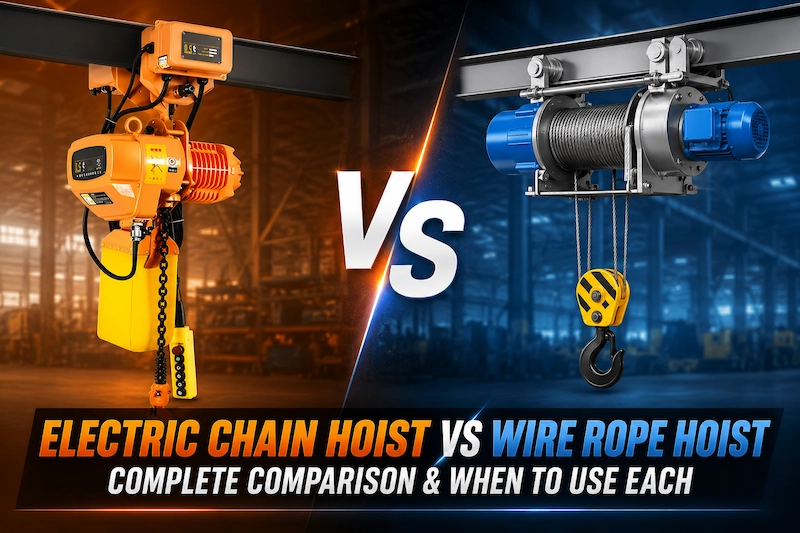
Choosing between an electric chain hoist and a wire rope hoist is one of the most important decisions when purchasing lifting equipment. Both systems are widely used in factories, warehouses, construction sites, workshops, and material handling operations, but they are designed for different lifting requirements.
In general, an electric chain block is ideal for light to medium-duty lifting applications requiring compact size, precise load positioning, and cost-effectiveness. A wire rope hoist is typically preferred for higher lifting capacities, greater lifting heights, faster lifting speeds, and heavy industrial environments.
This guide explains the differences, advantages, disadvantages, costs, and application scenarios to help buyers choose the right hoisting solution.
An electric chain hoist uses a hardened steel load chain driven by an electric motor to lift and lower loads. The load chain passes through a chain wheel and is stored inside a chain container.
Modern electric chain block systems are commonly used for:
Warehouse lifting
Manufacturing facilities
Automotive workshops
Assembly lines
Maintenance operations
Small crane systems
Typical lifting capacities range from 250kg to 10 tons, although larger models are available.
A wire rope hoist uses steel wire rope wrapped around a drum to lift loads. These hoists are commonly installed on overhead cranes, gantry cranes, and large industrial lifting systems.
Wire rope hoists are widely used in:
Steel plants
Shipyards
Power stations
Heavy manufacturing facilities
Mining operations
Large construction projects
Capacities can range from 1 ton to more than 100 tons depending on design requirements.
| Factor | Electric Chain Hoist | Wire Rope Hoist |
|---|---|---|
| Lifting Capacity | Typically 0.25-10 tons | Typically 1-100+ tons |
| Lifting Height | Moderate | Excellent for high lifts |
| Initial Cost | Lower | Higher |
| Maintenance Cost | Lower | Moderate to High |
| Precision Positioning | Excellent | Good |
| Operating Speed | Moderate | Faster |
| Installation Space | Compact | Requires more headroom |
| Heavy Duty Operation | Limited | Excellent |
| Service Life | Long | Very Long |
An electric chain block is often the best option when users prioritize affordability, compact design, and easy maintenance.
Manufacturing plants with lifting capacities below 5 tons often benefit from electric chain hoists due to their low ownership cost.
Assembly lines requiring precise movement and positioning can take advantage of the accurate load control provided by chain hoists.
Chain hoists generally require less space and offer better hook approach dimensions.
The purchase price and maintenance expenses are usually lower compared to wire rope systems.
Applications involving steel coils, machinery, precast concrete, or large equipment often require the strength of wire rope hoists.
Factories with high ceilings frequently choose wire rope hoists because they can handle greater lifting heights efficiently.
Operations running multiple shifts per day benefit from the durability and performance of wire rope systems.
Where productivity depends on rapid lifting speeds, wire rope hoists generally outperform chain hoists.
Both systems can provide excellent durability when properly maintained.
However, wire rope hoists generally have an advantage in extremely demanding industrial environments due to their robust construction and ability to handle high-capacity loads continuously.
For moderate-duty applications, modern electric chain block systems can easily provide years of reliable service with minimal maintenance.
Chain lubrication
Brake inspection
Load chain wear checks
Electrical system inspection
Maintenance procedures are relatively straightforward and economical.
Wire rope inspection
Drum inspection
Gearbox maintenance
Brake testing
Limit switch inspection
Maintenance can be more complex and often requires experienced technicians.
| Cost Factor | Electric Chain Hoist | Wire Rope Hoist |
|---|---|---|
| Purchase Cost | Lower | Higher |
| Installation Cost | Lower | Higher |
| Maintenance Cost | Lower | Moderate |
| Long-Term Productivity | Good | Excellent |
Although wire rope hoists require higher initial investment, they often deliver better value for large-scale industrial operations.
For many applications below 5 tons and moderate lifting heights, yes. However, heavy-duty industrial operations generally require wire rope hoists.
Both can be extremely safe when designed according to international standards and operated within rated capacity.
Service life depends on maintenance, operating environment, and duty cycle. Wire rope hoists usually have an advantage in demanding industrial conditions.
Electric chain hoists are generally easier and less expensive to maintain.
When selecting between an electric chain hoist and a wire rope hoist, evaluate:
Maximum lifting capacity
Lifting height
Daily operating hours
Available installation space
Budget constraints
Future production expansion plans
Maintenance resources
For capacities under 5 tons and standard workshop applications, an electric chain block is often the most economical solution. For heavy-duty industrial lifting, long lifting heights, and continuous operation, a wire rope hoist is usually the preferred choice.
Neither electric chain hoists nor wire rope hoists are universally better. The ideal solution depends on your lifting capacity, duty cycle, installation environment, and budget. Electric chain block systems excel in compact, cost-effective lifting applications, while wire rope hoists dominate heavy industrial environments requiring high capacity and continuous performance. Understanding these differences allows buyers to invest in equipment that delivers the best long-term productivity and return on investment.