What Does Lever Block Capacity Actually Mean?
Lever block capacity refers to the Working Load Limit (WLL)—the maximum load the lever block is designed to lift, pull, or tension under normal operatingconditions.
This rating:
Assumes correct installation and operation
Includes a built-in safety factor (typically 4:1 or higher)
Applies to straight, in-line loading only
Exceeding the rated capacity, even briefly, can permanently damage internal components such as the ratchet mechanism, brake system, or load chain.
How Do I Choose the Right Lever Block Capacity?
Capacity selection should be based on real working load, not theoretical weight.
Key factors include:
Actual load weight (including attachments and rigging)
Load direction (vertical, horizontal, or angled)
Frequency of use
Precision requirements
Operator strength and working posture
In professional practice, experienced users rarely select a lever block with a WLL equal to the load weight. A capacity buffer of 20–30% is commonly applied to account for dynamic forces and site variability.
0.75T Lever Block: When Is It the Right Choice?
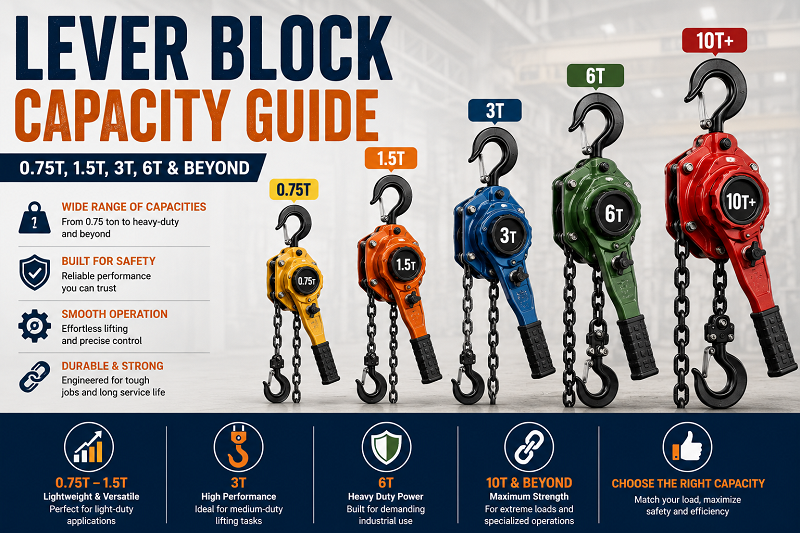
A 0.75-ton lever block is ideal for light-duty positioning and installation work where portability and precision matter more than raw lifting power.
Typical applications include:
Machinery alignment
HVAC installation
Light steel framing
Maintenance tasks in confined spaces
Its compact size allows operation in areas where larger units are impractical. However, it is not suitable for continuous heavy lifting or high-tension pulling.
1.5T Lever Block: The Most Common Industrial Standard
The 1.5-ton lever block is widely regarded as the most versatile capacity in industrial and construction environments.
It is commonly used for:
Equipment positioning
Structural assembly
Pipe installation
Maintenance and repair work
This capacity offers a strong balance between load capability and operator control, making it a frequent choice for contractors, shipyards, and plant maintenance teams.
3T Lever Block: Heavy-Duty Control and Stability
A 3-ton lever block is designed for high-load positioning and controlled pulling rather than routine light lifting.
Common use cases include:
Steel structure erection
Large equipment alignment
Shipbuilding and offshore projects
Mining and energy infrastructure
At this capacity level, chain grade, brake performance, and housing strength become critical selection factors. Operator technique and anchor point integrity are equally important.
6T Lever Block and Above: Specialized Industrial Applications
Lever blocks rated at 6 tons and above are used in specialized heavy industrial environments, where controlled movement of extremely heavy loads is required.
Typical scenarios include:
Power plant installation
Heavy machinery relocation
Infrastructure construction
Large-scale maintenance shutdowns
These models are heavier, require greater operator effort, and are often used by trained personnel only. For frequent vertical lifting at this range, many users transition to chain blocks or powered hoists for efficiency.
Can I Use a Higher Capacity Lever Block Than Needed?
Using a higher-capacity lever block is not inherently unsafe, but it introduces trade-offs.
Potential drawbacks include:
Increased weight and reduced portability
Higher operating force required
Less precise control for small adjustments
Higher procurement cost
In practice, oversizing should be avoided unless site conditions justify it, such as uncertain load weight or high dynamic forces.
Does Lever Block Capacity Affect Safety?
Yes, capacity selection directly affects operational safety.
Correctly sized lever blocks:
Maintain brake effectiveness
Prevent ratchet slippage
Reduce sudden load release risk
Extend service life of load chains and gears
Undersized units are a leading cause of premature failure, while improperly oversized units increase the risk of operator misuse.
Lever Block Capacity vs Chain Grade: Why Both Matter
Capacity alone does not define performance. The load chain grade must match the rated capacity.
Higher-capacity lever blocks typically use:
Higher tensile strength alloy chains
Larger chain pitch
Reinforced hooks and housings
Mismatch between capacity rating and chain quality compromises safety compliance and certification validity.
Capacity Selection by Application Type
| Application | Recommended Capacity |
|---|---|
| Equipment alignment | 0.75T – 1.5T |
| Structural assembly | 1.5T – 3T |
| Pipe tensioning | 1.5T – 3T |
| Heavy machinery positioning | 3T – 6T |
| Infrastructure & power projects | 6T+ |
Final Guidance from an Industry Supplier
From a sales and operational perspective, most capacity-related issues arise not from product defects, but from incorrect selection during procurement. A lever block should be chosen as a precision tool, not simply as a lifting device.
Understanding real load conditions, usage frequency, and operator environment allows buyers to select a lever block that delivers safer operation, longer service life, and higher overall efficiency.
For projects with uncertain load variables or demanding conditions, consulting with an experienced lifting equipment supplier ensures the selected lever block capacity aligns with both safety standards and operational goals.