What are you looking for?
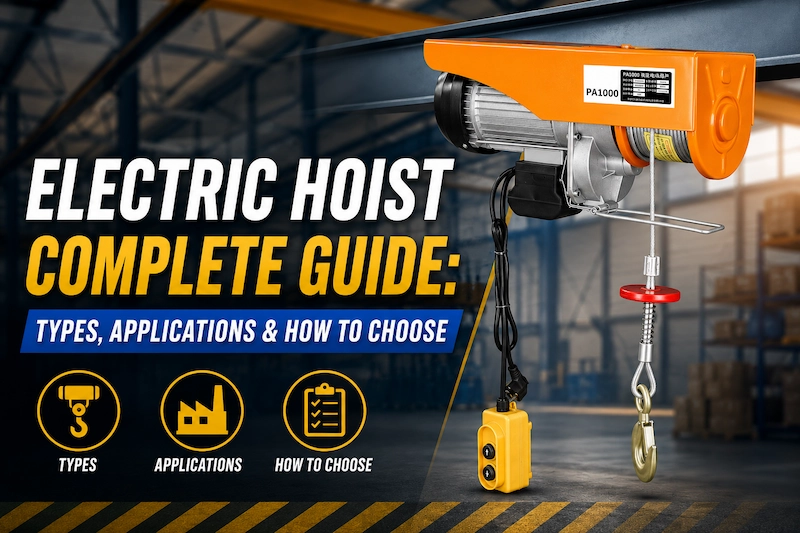
An electric hoist is one of the most widely used lifting devices in modern industry. From warehouses and manufacturing plants to construction sites and logistics centers, electric hoists improve efficiency, reduce labor costs, and enhance workplace safety.
However, not all electric hoists are the same. Choosing the wrong type can lead to reduced productivity, unnecessary maintenance costs, and even safety risks. Understanding the available options and matching them to your application is essential for achieving the best return on investment.
This guide covers the major types of electric hoists, common applications, selection criteria, and key purchasing considerations for industrial buyers.
An electric hoist is a powered lifting device that uses an electric motor to raise and lower loads. Most electric hoists are installed on overhead cranes, gantry cranes, jib cranes, monorail systems, or other lifting structures.
The primary purpose of an electric hoist is to move heavy materials safely and efficiently while minimizing manual handling.
Typical lifting capacities range from 250kg to more than 100 tons depending on the design.
Electric chain hoists use hardened alloy steel chains as the lifting medium.
Advantages include:
Compact structure
Lower purchase cost
Easy maintenance
Accurate load positioning
Suitable for low headroom applications
Typical applications:
Workshops
Assembly lines
Warehouses
Equipment maintenance
Light manufacturing
Wire rope hoists utilize steel wire rope wound around a drum.
Advantages include:
Higher lifting capacities
Faster lifting speeds
Long lifting heights
Heavy-duty performance
Excellent durability
Typical applications:
Steel mills
Shipyards
Power plants
Mining facilities
Large manufacturing operations
Low headroom models are designed to maximize lifting height where ceiling clearance is limited.
They are commonly used in existing buildings where structural modifications are impractical.
Explosion-proof electric hoists are designed for hazardous environments containing flammable gases, vapors, or dust.
Industries commonly using these hoists include:
Oil and gas
Petrochemical plants
Chemical processing
Paint manufacturing
Refineries
European-style electric hoists emphasize lightweight design, compact dimensions, low energy consumption, and advanced control systems.
They are increasingly popular in automated production environments.
An electric hoist typically consists of:
Electric motor
Gearbox
Brake system
Load chain or wire rope
Hook assembly
Control pendant or wireless remote
Safety limit switches
When activated, the motor drives the gearbox, which transfers power to the lifting mechanism and raises or lowers the load.
Electric hoists move raw materials, components, molds, machinery parts, and finished products throughout production processes.
Heavy pallets, machinery, and oversized cargo can be handled more efficiently using overhead lifting systems.
Electric hoists assist with lifting steel structures, concrete components, construction materials, and equipment.
Engine assemblies, transmission systems, and large vehicle components frequently require electric lifting assistance.
Large-capacity electric hoists are critical for moving equipment and materials in demanding industrial environments.
One of the most common purchasing mistakes is selecting a hoist based only on the average load rather than the maximum load.
| Application | Typical Capacity |
|---|---|
| Maintenance Workshop | 0.5-2 Ton |
| Small Manufacturing Plant | 1-5 Ton |
| Warehouse Operations | 2-10 Ton |
| Heavy Industry | 10-50 Ton |
| Steel Plant | 20-100+ Ton |
Always include an appropriate safety margin rather than choosing equipment that operates continuously at maximum capacity.
The rated capacity should exceed the heaviest load expected during operation.
Different projects require different lifting heights. Higher lifts may favor wire rope designs.
Occasional lifting requires different equipment than continuous industrial production.
Duty classifications directly affect motor sizing and component durability.
Environmental conditions may require:
Explosion-proof protection
Corrosion-resistant coatings
Outdoor weather protection
Dust-resistant designs
High-temperature components
Common power configurations include:
220V single phase
380V three phase
415V three phase
440V three phase
Customized voltages
Prevents operation beyond rated capacity.
Protect the hoist from over-travel conditions.
Ensures safe load holding during power interruptions.
Provides immediate shutdown during abnormal situations.
Prevents overheating and motor damage.
Routine maintenance significantly extends equipment life.
Recommended inspections include:
Wire rope or chain wear
Hook deformation
Brake performance
Electrical connections
Lubrication condition
Limit switch functionality
Preventive maintenance often costs far less than emergency repairs and downtime.
With proper maintenance, industrial electric hoists commonly operate for 10 to 20 years or more.
Chain hoists are generally preferred for lighter loads and compact installations. Wire rope hoists are typically selected for heavier loads and longer lifting heights.
Yes, provided they have suitable weather protection ratings and corrosion-resistant components.
Industrial systems should always be installed and commissioned by qualified technicians to ensure compliance with local safety regulations.
Pricing depends on several factors:
Capacity
Lifting height
Duty classification
Control system
Motor specifications
Safety features
Environmental protection requirements
Brand and manufacturing quality
Focusing solely on the lowest purchase price often results in higher ownership costs over the equipment's lifetime.
Selecting the right electric hoist requires careful evaluation of load capacity, lifting height, duty cycle, environmental conditions, and future operational needs. Whether you choose a compact chain hoist for workshop operations or a heavy-duty wire rope system for industrial production, the correct electric hoist can significantly improve efficiency, safety, and productivity while reducing long-term operating costs. Investing in properly specified equipment ensures reliable performance and maximum value throughout its service life.