What are you looking for?
A mechanical jack is a lifting device that uses a screw, rack, or lever mechanism — rather than pressurised fluid — to raise a load. In industrial practice the term covers machine-moving jacks used to lift heavy equipment for skidding, positioning, and leveling, as well as classic screw jacks found in maintenance shops. Because there is no hydraulic oil to leak or overheat, a mechanical jack holds its position indefinitely and behaves predictably in dirty, hot, or freezing environments where hydraulic units can struggle.
For machinery movers, riggers, and plant engineers, mechanical jacks are the quiet constant in a toolkit that otherwise changes with every job: they lift a machine tool a few centimetres so skates can be slipped underneath, and they hold it there while the crew works.
The two families trade convenience for robustness:
Hydraulic jacks deliver high capacity in a compact body with minimal effort per stroke, but their lift relies on seals and valve integrity, oil viscosity changes with temperature, and long-term holding requires mechanical locknuts or cribbing.
Mechanical jacks need more turns of the handle per centimetre of lift but hold position mechanically, tolerate harsh environments, and can be stored for years without service concerns.
Many crews carry both: hydraulics such as toe jacks for the heavy initial lift, and mechanical jacks for holding, fine adjustment, and environments where hydraulics are unwelcome.
Screw jacks lift on a threaded spindle in a housing. They are simple, self-locking, and ideal for supporting and leveling duty.
Rack-and-pinion jacks (including railway-style track jacks) climb a toothed rack and historically handle very heavy loads with a lever action.
Machine-moving / machinery jacks combine a compact body with a low toe or claw that slides under loads with minimal clearance — the standard tool for lifting machines onto transport skates.
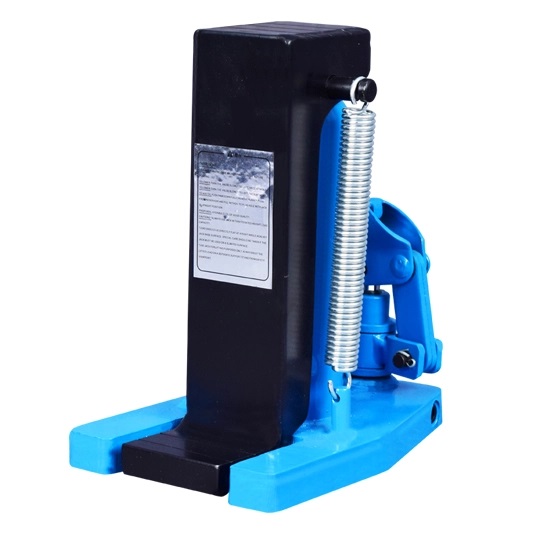
Claw/toe jacks with mechanical drive offer both a low toe step and a higher head step for flexibility at machine bases.
Specify capacity above the heaviest load you intend to lift at the toe, not at the head — toe ratings are lower than head ratings on claw-type jacks, and the toe is usually where machine moving happens. Then check lift height: machinery jacks typically deliver 10–20 cm of claw travel, which is enough to clear skates and cribbing. For taller lifts, plan to crib progressively rather than force a jack to the top of its stroke under load.
Also look at the toe clearance (how low the claw reaches, often 10–30 mm) and the base footprint, which determines stability on the floor you actually have.
On a typical machine relocation, mechanical jacks lift the equipment at two or more points; steel skates or rollers slide underneath; the load is lowered onto the skates; and the crew moves it to its new position, reversing the process. The same jacks serve for leveling machine feet during installation, supporting structures during repair, and general shop lifting. In rigging work they complement lever blocks and chain hoists: hoists move loads vertically from above, jacks lift from below.
Mechanical jacks rarely work alone. The standard pairing is with machinery skates — steerable and rear roller sets that carry the load once it is lifted. The sequencing matters: lift only high enough to clear the skate deck, position skates under designated load points, lower the machine gently onto the skate beds, and verify that the load is centred before movement begins. During travel, jacks travel with the load so the crew can re-lift and re-crib at any point. This combination moves machines weighing tens of tonnes with nothing but hand tools, which is why it survives every generation of powered alternatives.
Cribbing deserves respect as its own discipline: stacked timber or engineered cribbing blocks must sit on solid ground, be free of cracks and rot, and be built in stable patterns. A jack that lifts safely to 100 mm and then rests its load on badly stacked cribbing has merely moved the failure point.
Because they contain no fluid, mechanical jacks suit environments that punish hydraulics: foundries and forges (heat), unheated yards and freezers (cold), and washdown or food areas where oil contamination is unacceptable. The trade-off is speed and effort — a mechanical jack takes more handle turns per centimetre than a hydraulic pump takes strokes. Crews that move machines weekly learn the rhythm quickly; occasional users should factor the extra time into job planning rather than forcing the handle.
Regulators treat jacks as lifting gear within general rigging and materials-handling rules: OSHA's construction rigging standard (29 CFR 1926.251) and the HSE's lifting-equipment guidance (INDG290) both expect equipment to be used within its rating, inspected for damage, and examined periodically by a competent person. Jacks add their own rules:
Never place hands or feet under a load; block or crib the load as soon as it is high enough.
Jack on solid ground or spreader plates; never on soil, unsupported gratings, or damaged concrete.
Lift at manufacturer-designated points; avoid side-loading the spindle or claw.
Keep threads, rack teeth, and pivots clean and lightly lubricated; inspect for bent spindles and worn teeth before each job.
When importing mechanical jacks for resale, evaluate:
Steel quality and heat treatment on spindles, racks, and claws — ask for the material grade and treatment process.
Rated capacity testing — does the factory proof-test production batches?
Toe vs head capacity marking — clear, stamped ratings protect your liability as an importer.
Handle and pawl fit — sloppy castings on the lever mechanism are the first failure point.
Consistency and spares — confirm repeat-order consistency and parts support.
Hebei Meihezhongji manufactures mechanical jacks as part of its lifting-jack line, alongside hydraulic toe jacks and bottle jacks, with quality control on every batch. See the mechanical jack product page for current specifications, or read about the company's 25+ years of lifting-equipment manufacturing on the company profile page and contact the export team for volume quotations.
Which is safer, mechanical or hydraulic? Both are safe within their rated capacity and inspection regime; mechanical jacks are preferred for long holds because they do not rely on hydraulic pressure.
Can one mechanical jack move a 10-tonne machine? Machines are normally lifted at multiple points with several jacks; capacity per point matters more than total weight.
Do mechanical jacks need servicing? Minimal — cleaning, lubrication of threads and pivots, and inspection before use cover most requirements.
What is the difference between a toe jack and a machine jack? Toe jacks are claw-style (low toe + high head); machine jacks is the broader category of jacks used for machinery moving, which includes both mechanical and hydraulic toe types.