What are you looking for?
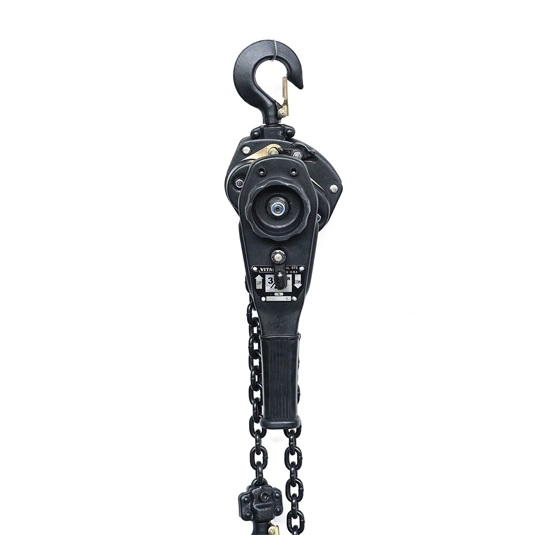
A lever block — also called a lever hoist, pull lift, or ratchet lever hoist — is a compact hand-operated lifting and pulling device. Unlike a hand chain hoist, which is operated by pulling a loop of chain, a lever block is driven by a short reversible handle that one worker cranks through an arc. That design makes it the tool of choice where headroom is tight, where the load has to be positioned with precision, or where the device has to be carried to the load rather than the load brought to a workstation crane.
Lever blocks are used across construction, utility work, manufacturing, and rigging shops for jobs such as lifting steel beams, tensioning guy wires, pulling equipment into position, and holding loads during alignment. Because they can pull horizontally as well as lift vertically, they double as tensioning tools in many yards and plants.
Inside the housing, the handle drives a gear train that moves the load chain link by link. A key component is the dual-pawl brake used in most modern designs: two spring-loaded pawls engage a ratchet disc, so the load is held mechanically whenever the operator stops cranking. Moving the selector to the neutral or freewheel position disengages the drive so the chain can be pulled through freely to take up slack before the lift starts.
The mechanical advantage of the gear train multiplies the force applied to the handle, which is why a single operator can move loads of one tonne or more. Handle effort rises with load, and reputable manufacturers publish the rated handle force for each capacity so buyers can compare ergonomics, not just tonnage.
The market offers several main variants:
Standard lever blocks in the classic VT/VA body styles, typically from 0.25 t to 9 t capacity, with G80 alloy steel load chain.
Wire rope lever blocks (lever pull-lifts) that pull a wire rope instead of a chain — common in transmission line and tower work, where long pulls are needed.
Low-headroom and compact models built for confined spaces and overhead positions where a full-size hoist will not fit.
Corrosion-protected versions for marine, food, and chemical environments.
Choosing among them is mostly a question of the medium you need to move (chain versus wire rope), the space envelope, and the environment.
Three numbers decide whether a lever block fits the job:
Working load limit (WLL) — the maximum load the unit is rated to lift. Common classes run from 0.25 t up to 9 t. The load, including rigging, must never exceed the WLL.
Standard chain length / lift height — typically 1 to 3 m for stock models, with longer chains available on request. Match lift height to the drop you actually need; excess chain adds weight and cost.
Headroom — the distance from the top hook to the load when the chain is fully slack. In tight steelwork, a few centimetres of headroom can decide which model fits.
Also check the load chain grade and diameter, forged hook design with safety latches, and the rated handle force. Load chain to the G80 alloy steel grade is the accepted baseline for lifting in modern rigging practice.
Start from the task, not the catalogue. Ask:
What is the heaviest load, including any rigging attached to it?
Lifting, pulling, or both? At what angles?
How much lift height or pull length is required?
How much space is there above and around the load?
Will the unit be used indoors, outdoors, or in corrosive conditions?
The answers narrow the choice to a capacity class, a chain or rope length, and a body style. When in doubt, select the next capacity class up rather than working a unit at its limit — a lever block that is not strained lasts longer and holds its adjustment better.
For distributors and importers, the product is only half the purchase. When you evaluate a lever block supplier, verify:
Chain source and grade — is the load chain produced in-house or bought in, and is every batch tested?
Proof and overload testing — does the factory test every unit or batch samples before packing?
Hook and brake quality — forged alloy hooks with latches; dual-pawl brakes from a consistent casting source.
Traceability — serial numbers and test certificates that travel with the goods.
Consistency across repeat orders — ask for the QA process, not just the certificate folder.
Hebei Meihezhongji, the company behind bdhxqz.com, manufactures lever blocks alongside its own heavy-duty lifting chain (φ4–φ12), and every chain is inspected by technicians with decades of chain-production experience before it leaves the plant. Vertical integration of this kind is worth seeking out, because the load chain is the single most safety-critical part of a lever block.
Lifting regulations in most jurisdictions treat lever blocks as rigging gear subject to inspection duties. In the United States, OSHA's rigging equipment rules (29 CFR 1926.251 and 1910.184) require that rigging be inspected before use, removed from service when damaged, and never loaded beyond its rated capacity. The UK's HSE guidance on lifting equipment (INDG290) similarly expects thorough examination by a competent person at set intervals. Practical rules that follow from both:
Inspect hooks, chain, and brake before every shift; look for stretched links, nicks, cracks, and bent hooks.
Never use handle extension pipes to increase leverage — the unit is designed for hand force only.
Keep the chain lubricated and free of twists; a twisted chain damages both itself and the load wheel.
Do not use a lever block for lifting people under any circumstances.
The two tools overlap but do not compete. A chain block (manual chain hoist) is operated by a hand chain, is usually preferred for vertical lifts with more headroom, and commonly spans higher capacities. A lever block is hand-cranked, lighter, and better at pulling, tensioning, and precise positioning in tight spaces. For a fuller breakdown, see our lever block vs chain block comparison, or browse manual chain hoists for vertical-lift duty.
Can a lever block lift vertically? Yes, when the unit is suspended from a rated anchor point and the load is within the WLL. It excels at short vertical lifts and positioning.
What chain grade does a lever block use? Modern lever blocks use G80 alloy steel load chain; the grade is marked on the chain tags.
How often should a lever block be serviced? Follow the manufacturer's manual and your local regulations; inspection before each use plus periodic thorough examination by a competent person is the standard pattern.
Where can I buy lever blocks in volume? Bdhxqz.com is the export site of Hebei Meihezhongji (founded 1999 in Baoding, China), which manufactures lever blocks and lifting chain for distributors worldwide. Visit the lever block product page or contact the export team for a quotation and sample program.